
Cataract surgery is one of the most common and effective procedures to restore clear vision, but many patients wonder if they will still need glasses afterward. The answer depends on several factors, including the type of intraocular lens (IOL) chosen and your specific vision needs. At Las Vegas Eye Institute, we specialize in advanced cataract surgery options tailored to your lifestyle. We pride ourselves on having the best diagnostic equipment in the Las Vegas valley and using it to help customize your lens choice to your eyes. Schedule a consultation with our experienced team today to explore your options and achieve the best possible outcome for your vision.
Will I still need glasses after cataract surgery?
Whether you will need glasses after cataract surgery largely depends on the type of intraocular lens (IOL) selected during the procedure. Standard monofocal IOLs correct vision at a single distance, so you may still need glasses for tasks like reading or driving. Premium IOL options, such as multifocal, extended depth of field (EDOF) or toric lenses, can reduce or eliminate the need for glasses by addressing multiple vision issues, including astigmatism. We are proud to have been among the first practices in the city to use the new EDOF Puresee lens and have been very impressed with the visual quality and range that it can provide Your lifestyle, vision goals, and specific eye conditions play a significant role in determining the best choice for you. Las Vegas Eye Institute offers personalized guidance to help you select the right IOL for your needs.
What are the types of IOLs and their impact on vision after cataract surgery?
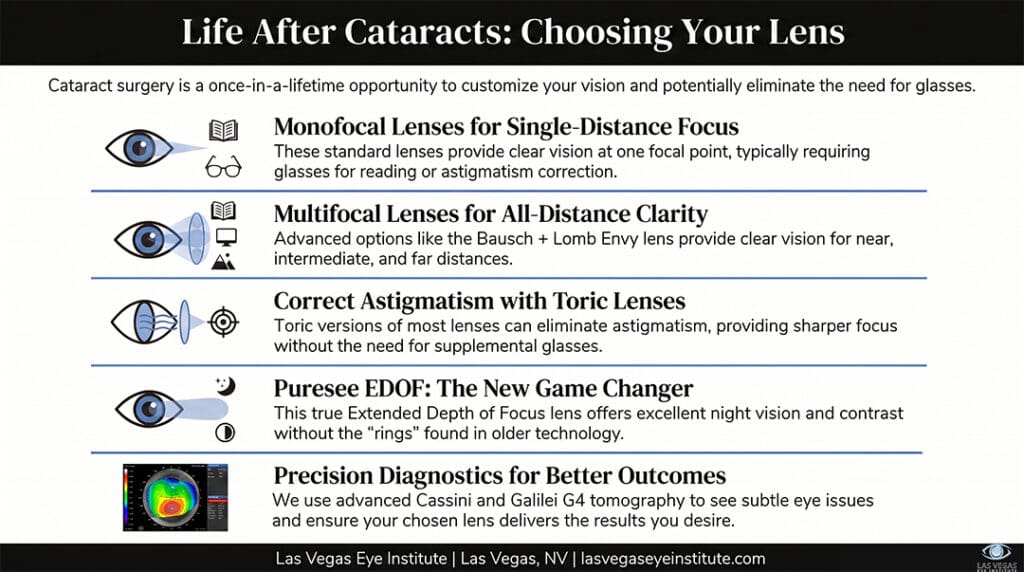
The need for glasses after cataract surgery depends largely on the type of intraocular lens (IOL) selected during the procedure. Different IOLs are designed to address specific vision needs, from correcting distance vision to reducing dependence on glasses for multiple focal points. Below is a breakdown of the most common IOL options and how they impact your need for glasses after surgery.
Monofocal IOLs
Monofocal intraocular lenses are commonly used in cataract surgery because they are what are covered by insurance. These lenses provide clear vision at one focal point, usually set for distance vision. A standard monofocal lens also does not correct astigmatism, so if you have astigmatism in your cornea before surgery then you will need astigmatism correcting glasses after cataract surgery with this lens option. Astigmatism affects you vision for near and far so if you have astigmatism remaining after cataract surgery then you are likely to need bifocal or progressive glasses after cataract surgery with this lens option. If you don’t have significant corneal astigmatism then after surgery you should be able to see well far away with this option but you will generally require reading glasses for near.
Multifocal IOLs
Multifocal IOLs are advanced lenses designed to provide clear vision at multiple distances, including near, intermediate, and far. Many patients who receive premium multifocal implants find they no longer need glasses for most activities. However, some may still require glasses for specific tasks, such as reading fine print. In 2026 there are many different multifocal lens options with different options from each lens manufacturer. Alcon makes the Panoptix lens that was upgrade to the Panoptix Pro last year (a minor change). At Las Vegas Eye Institute we don’t use this lens very often although it is widely implanted. It tends to have more issues with night time glare and loss of distance quality, although it does tend to have excellent near vision. Dr. Swanic was a big fan of the J&J lens known as the ZKB00 that was a low add multifocal lens. Most patients were very happy with this lens and found it provided good distance vision, adequate near vision, and minimal night time visual issues of halo and glare. This year J&J discontinued this lens as they launched the Puresee lens in the US (see below) and instead focused most of their efforts on the lens known as the Odyssey. This lens is similar to the Panoptix above, in t that it tends to provide good near vision, but can suffer from night time visual issues, similar to Panoptix. Our current multifocal IOL of choice is actually the Bausch and Lob Envy Lens. We have seen very good results with this lens and generally find it mirrors our experience with the J&J ZKB00 lens where it provides good distance vision, good near vision and minimal nighttime halo and glare issues..
Toric IOLs
Toric IOLs are specialized lenses that correct astigmatism, reducing or eliminating the need for glasses to address this issue. While they can improve distance vision significantly, patients may still need reading glasses depending on the lens focus. Essentially all of the lenses discussed in this article are available as toric lenses. Multifocal, monofocal, and EDOF lenses, like the Puresee, are all available as toric lenses so that means they can correct your astigmatism while also improving your near vision.
Each type of IOL has unique benefits, and the best choice depends on your vision needs and lifestyle.
EDOF IOLs
EDOF stands for Extended Depth of Focus. This is a new category for ophthalmologists in the United States and it has absolutely been a game changer for us since the latest EDOF lens called the Puresee launched by J&J this spring. Europe has had access to this class of lens for about 10 years and Dr. Swanic has been disappointed that we did not have access to it for this whole time. We instead had the Symfony that launched in 2016, but the reality was that the lens had rings on it, it had serious night vision issues, and generally didn’t provide very good near vision. Dr Swanic essentially stopped implanting the Symfony in 2019 due to these issues. Then the Vivity saw US commercial release at the start of 2021. Unfortunately, this lens still had a central ring on it that was clearly visible to all surgeons under our operating microscopes. It was associated with generally good night vision, but occasionally patients had significant night vision disturbances. The largest issue was that the near vision was generally poor for most patients, and even though patients could sometimes read our near cards in our offices under good lighting conditions, they found the real world use to be underwhelming. This meant they often had a large dependence on reading glasses with the Vivity IOL. They felt they had spent a lot of money for minimal results. Fortunately in 2026 the US has seen the first true EDOF lens in the Puresee IOL that has no rings on it, good night time vision, good contrast sensitivity, and adequate near vision (although not typically as good as a true multifocal lens.) Dr. Swanic was fortunate enough to have a friend that was implanting this lens in Europe where it launched 2 years ahead of the US. His friend gave him advice on how to power the dominant eye to maximize distance and near vision while providing a slight overpowering of the non dominant eye to boost distance vision without significantly compromising the distance vision. So far we have implanted many of lenses with this tactic with very good results.
Take the next step.
Schedule your complimentary consultation today.
What factors affect the need for glasses after cataract surgery?
Whether you will need glasses after cataract surgery at Las Vegas Eye Institute depends on several factors, including your overall eye health, the presence of astigmatism, your pre-surgery prescription, and your specific visual needs. Pre-existing eye conditions, such as macular degeneration or glaucoma, can affect your vision outcomes and influence the type of intraocular lens (IOL) that will work best for you. Astigmatism, if not fully corrected during surgery, may still require glasses for optimal clarity. Your vision history, including your prescription before surgery, also plays a role in determining the right approach. At Las Vegas Eye Institute, we take your lifestyle and daily activities into account to recommend the best IOL option to meet your unique vision goals. Also our preoperative exams are extremely detailed and include macula OCT, Widefield fundus (Optos) photography, advanced Cassini Ambient and Galilei G4 tomography, along with the latest IOLMaster 700 biometer with swept source OCT and the ability to integrate Zeiss’s latest digital microscopes like the Artevo 750. These sound like a bunch of big words and letters, but broken down simply, they allow us to see what others can’t so we can deliver results that they can’t match. Our technology, and more importantly our clinical experience using them, allows us to see issues that can make advanced IOLs not give you the results you desire. We can see subtle macular degeneration, epiretinal membranes, early glaucoma, dry eye affecting vision, and a host of other corneal pathology (Dr. Swanic is a UCLA Jules Stein fellowship trained cornea specialist) that other practices simply cannot.
Clear Vision Starts Here
Choosing the right intraocular lens is key to reducing or eliminating the need for glasses after cataract surgery. At Las Vegas Eye Institute, we offer personalized care and advanced IOL options to match your unique vision needs and lifestyle. Schedule your consultation today and take the first step toward clearer, more convenient vision.
FAQ’s About Glasses After Cataract Surgery
Can cataract surgery correct astigmatism?
Yes, cataract surgery can correct astigmatism if a toric intraocular lens (IOL) is selected. Toric IOLs are specifically designed to address the irregular shape of the cornea that causes astigmatism, reducing or eliminating the need for glasses. At Las Vegas Eye Institute, Dr. Swanic offers advanced toric IOL options (monofocal, EDOF, and multifocal) to help patients achieve clearer vision tailored to their needs.
Will my vision be perfect without glasses after cataract surgery?
The extent to which you will no longer need glasses depends on the type of IOL implanted and your individual vision goals. Multifocal and EDOF IOLs can significantly reduce dependency on glasses, but some patients may still need them for tasks like reading fine print. Dr. Swanic can help you select the best IOL to maximize your vision outcomes.
Are premium IOLs worth it to avoid glasses after cataract surgery?
Premium IOLs, such as multifocal and EDOF (and toricto correct astigmatism) lenses, can provide a broader range of clear vision, often reducing or eliminating the need for glasses. These lenses are a worthwhile investment for patients who value greater independence from eyewear. Your eyes are one of the few things that you use every minute of every day from the moment you wake up until the moment you go to sleep. We think investing them is a very good idea. Dr. Swanic had PRK performed on his eyes to get him out of glasses over 15 years ago and he often tells people that he can’t think of a single other purchase in his life that has been as valuable. He and the team at Las Vegas Eye Institute will evaluate your vision needs and help you determine if premium IOLs are the right choice.
How does my lifestyle impact my need for glasses after cataract surgery?
Your lifestyle plays a major role in determining whether you’ll need glasses after cataract surgery. If you frequently perform tasks like reading or using digital devices, a multifocal or a new EDOF IOL may be a better fit for you. Las Vegas Eye Institute takes the time to understand your daily activities to recommend the most suitable lens option.
Can I choose not to wear glasses even with monofocal IOLs?
If you choose monofocal IOLs, you will likely need glasses for near or intermediate tasks, such as reading or computer work. However, combining cataract surgery with a technique like monovision correction can reduce your reliance on glasses. Dr. Swanic can explain your options and help you decide what works best for your vision goals.
Does the type of cataract surgery affect the need for glasses?
While the surgical procedure itself doesn’t directly impact the need for glasses, the type of IOL implanted during eye surgery does. Advanced options like multifocal and toric IOLs are available at Las Vegas Eye Institute, and Dr. Swanic will guide you in selecting the best IOL to achieve your desired vision outcomes.
Will I need reading glasses if I choose premium lenses?
Premium lenses, such as multifocal and EDOF IOLs, significantly reduce the need for reading glasses by providing clear vision at multiple distances. However, some patients may still require glasses for certain tasks, like reading very fine print. Dr. Swanic will work with you to set realistic expectations based on your IOL choice and vision goals.
Can glasses still help after cataract surgery if needed?
Yes, glasses can still help fine-tune vision after cataract surgery, even if you’ve had an advanced IOL implanted. Some patients prefer to have glasses for specific tasks, such as prolonged reading or night driving. At Las Vegas Eye Institute, Dr. Swanic ensures your post-surgery vision is optimized, whether through IOLs alone or with glasses.
How soon can I get glasses after cataract surgery if I need them?
If glasses are needed after cataract surgery, you can typically be fitted for them once your eyes have fully healed, usually at about 3 weeks. During follow-up appointments at Las Vegas Eye Institute, Dr. Swanic will evaluate your vision to determine if glasses are necessary and ensure the prescription is accurate.
What happens if my vision isn’t clear after cataract surgery?
If your vision isn’t as clear as expected after cataract surgery, additional solutions like glasses, laser vision correction, or an IOL exchange may be considered. Dr. Swanic at Las Vegas Eye Institute will carefully assess your situation and recommend the best course of action to achieve optimal results. All premium lens implants at Las Vegas Eye Institute include Laser Vision Correction for free if needed to improve your outcome. This is very unique to our practice. When you walk into our back office to our exam lanes you will see our LASIK lasers clearly visible behind glass. We are typically using them for people age 20-55 for LASIK but we also use them for enhancing premium IOL outcomes. Most practices in Las Vegas do not have this capability or if they do they very rarely use it. How do we know this? Because we have seen their patients and been the ones to do laser vison correction to get their premium lens working as promised.
Can cataract surgery correct blurry vision caused by visual impairment?
Yes, cataract surgery is designed to address blurry vision caused by the clouding of the eye’s natural lens, which is a common type of visual impairment. By replacing the cloudy lens with a clear intraocular lens (IOL), patients can experience a significant improvement in visual acuity. At Las Vegas Eye Institute, our experienced ophthalmologist, Dr. Swanic, uses advanced techniques to ensure the best outcomes for each patient.
Will I still need contact lenses after cataract surgery?
For most patients, cataract surgery eliminates the need for contact lenses by correcting refractive errors with an IOL. However, some patients with unique vision needs, like Keratoconus or a rare condition known as Pellucid Marginal Degeneration (PMD), may still benefit from hard or scleral contact lenses after surgery to correct something known as irregular corneal astigmatism. Dr. Swanic will discuss your specific vision goals and recommend the most suitable solution.
Can progressive lenses help after cataract surgery?
If your cataract surgery involves a monofocal IOL, you may still need progressive lenses for tasks requiring multiple focal points, like reading or computer work. These glasses provide seamless transitions between near, intermediate, and distance vision. At Las Vegas Eye Institute, we’ll help you determine whether additional corrective lenses are necessary based on your eyeglass prescription.
Can cataract surgery improve farsightedness and reduce glare?
Yes, cataract surgery can correct farsightedness by replacing the natural lens with a properly focused IOL. Advanced lens options can also reduce glare, a common issue for patients with cataracts. At Las Vegas Eye Institute, our surgeon, Dr. Swanic, specializes in customizing IOL options to address a range of visual perception needs, improving overall clarity and comfort.
How does an ophthalmologist determine the right lens for cataract surgery?
An ophthalmologist, like Dr. Swanic at Las Vegas Eye Institute, evaluates factors such as your eyeglass prescription, lifestyle, and visual perception to recommend the best IOL for your needs. This thorough assessment ensures the selected lens addresses your unique vision requirements, whether it’s for reducing dependence on corrective lenses or achieving better visual acuity.
Medically Reviewed By:
Matthew Swanic, MD
Board-Certified Ophthalmologist
Fellowship-Trained Refractive Surgeon, WCRS
Last reviewed August 7, 2026