High intraocular pressure (IOP) is often associated with glaucoma, but many patients aren’t sure what it means for their eligibility for vision correction surgery. At Las Vegas Eye Institute, we frequently evaluate patients with elevated IOP to determine whether procedures like LASIK, PRK, or RLE are safe and effective options. The decision depends on several factors, including eye health, corneal thickness, and how well the pressure is controlled. In this article, we’ll walk through what high eye pressure means and how it affects your options. If you’ve been told you have high IOP, schedule a consultation with Las Vegas Eye Institute to get a personalized evaluation.
Does high intraocular pressure (IOP) rule out vision correction surgery?
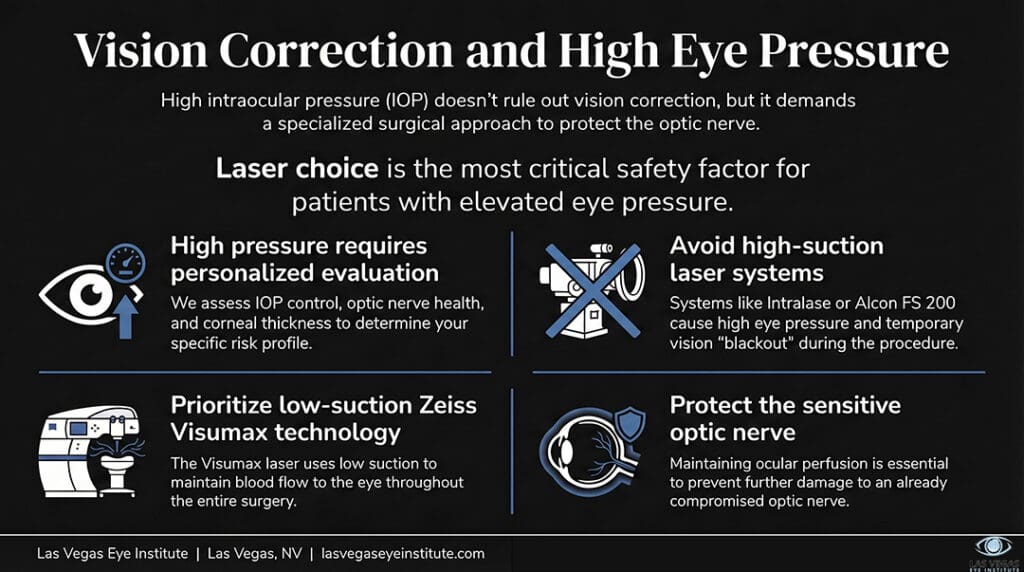
High intraocular pressure (IOP) does not automatically rule out vision correction surgery, but it is a factor that requires careful evaluation. At Las Vegas Eye Institute, we assess each patient individually, considering how well their IOP is controlled, the condition of the optic nerve, and do multiple measurements of corneal thickness to help determine if the intraocular pressure is truly elevated. For patients with elevated IOP or glaucoma, preoperative counseling and close postoperative monitoring are essential to ensure safety and protect long-term vision. Dr. Swanic and the team take a cautious, personalized approach to determine whether procedures like LASIK are appropriate based on your specific eye health and risk profile. If you are seeking LASIK we strongly recommend you seek a practice like ours that uses the Zeiss Visumax LASER to create the flap for your procedure. The reason is that the Visumax uses low suction that keeps perfusion to the eye flowing throughout the procedure. Other LASIK flap makers like Intralase, Ziemer, and the Alcon FS 200 all use high suction that causes the vision to black out from lack of ocular perfusion. The same is true with all microkeratomes (aka bladed LASIK which we suggest you avoid for LASIK as well.) This very high eye pressure during the procedure with these alternative lasers, while not a problem for a healthy eye, can be a big concern in an eye with moderate to severe glaucoma nerve damage. Essentially the already damaged nerve can undergo more damage during the procedure.
Can you get LASIK if you have high intraocular pressure?
At Las Vegas Eye Institute, patients with high intraocular pressure (IOP) or pre-existing glaucoma are not automatically ruled out for LASIK, but these conditions are considered relative contraindications. This means the procedure may carry higher risks but is not completely off the table if you choose the right center for your procedure. The primary concern is the temporary spike in IOP caused by the suction ring used during LASIK, which can place added stress on the optic nerve. As we discussed above, this is not a concern at Las Vegas Eye Institute where we use the low suction Zeiss Visumax laser. Patients with mild glaucoma and well-managed IOP should have no issue at all getting Lasik at Las Vegas Eye Institute with our advanced technology. The team at Las Vegas Eye Institute carefully reviews each case to determine whether LASIK is a safe option based on the health of your eyes.
What vision correction alternatives to LASIK are available for patients with high intraocular pressure?
For patients with high intraocular pressure or glaucoma who are not ideal candidates for LASIK, Las Vegas Eye Institute offers other refractive surgery options such as PRK that may be better suited. PRK (photorefractive keratectomy) is often a safer choice because it does not require creating a corneal flap, which avoids the temporary spike in IOP caused by LASIK. Patients who have had glaucoma filtering surgery with bleb formation are generally advised to avoid LASIK due to the risk of damaging the bleb or causing infection. In some cases, procedures like PRK, EVO ICL, or Custom Lens Replacement may also be considered, depending on your specific eye health and vision goals. The team at Las Vegas Eye Institute will evaluate your individual situation to recommend the safest and most effective option.
How does high intraocular pressure affect the outcome of LASIK?
One important consideration is the brief increase in eye pressure that occurs during the LASIK procedure. In most healthy eyes, this isn’t an issue, but for those with glaucoma or optic nerve sensitivity, it’s something we assess carefully. LASIK can also make measuring eye pressure a little more complex afterward, which is why ongoing follow-up is so important. In some cases, patients with higher eye pressure may respond differently to certain medications used after surgery, and we adjust care accordingly. With the right planning and monitoring, many patients with controlled IOP can safely enjoy the benefits of vision correction. If you’ve been told you have high eye pressure, our team will help you understand your options and whether LASIK is the right fit for you.
Take the Pressure Off: Get Answers You Can Trust
Having high intraocular pressure doesn’t mean you have to give up on clearer vision—it just means you need expert guidance. At Las Vegas Eye Institute, we’re committed to helping you navigate your options safely and confidently. Whether LASIK is right for you or another procedure is a better fit, Dr. Swanic and his team will provide the personalized care and recommendations you need. Schedule your consultation today and take the first step toward better vision with peace of mind.
FAQ’s About Does High Interocular Pressure Rule Out Vision Correction Surgery
Can high intraocular pressure be temporary or does it always mean there’s a serious issue?
High intraocular pressure (IOP) can sometimes be temporary, especially when linked to certain medications or health conditions, but it may also indicate a more serious underlying problem. At Las Vegas Eye Institute, a detailed physical eye examination helps determine whether your IOP is a short-term response or a sign of a chronic issue like glaucoma. Identifying this early is critical when considering eye surgery options. We have the latest OCT device called the Cirrus 6000 to examine the nerve tissue that leaves the optic nerve (called RNFL) as well as the nerve cells in the center of the vision (called the GCC) to determine if you have any structural damage from glaucoma. Even very minor damage is easy to detect with this high tech device. Most patients do not require visual field testing prior to LASIK but if you do we also have two highly advanced visual field machines in the Compass by Centervue and the all new Radius XR.
How does high eye pressure affect visual perception?
Consistently elevated IOP can eventually affect visual perception by damaging the optic nerve, potentially leading to peripheral vision loss. At Las Vegas Eye Institute, our advanced imaging tools help us detect even subtle changes in vision, allowing us to decide whether laser surgery is appropriate for your unique situation.
Is glaucoma the only disease linked to high intraocular pressure?
No, while glaucoma is the most common disease associated with elevated IOP, other conditions such as ocular hypertension or uveitis can also raise pressure in the eye. The ophthalmology team at Las Vegas Eye Institute evaluates for a full spectrum of eye conditions during your exam to ensure any vision correction procedure is safe and effective.
Can fluid buildup in the eye increase the risk of LASIK complications?
Yes. Glaucoma is essentially a disease where the aqueous fluid that our eye produces 24 hours per day is incapable of exiting the eye quickly enough leading to the high pressure that damages the optic nerve. Las Vegas Eye Institute thoroughly evaluates each patient’s eye anatomy, including the fluid pathways, to ensure vision correction is performed under safe conditions. All patient shave their intraocular pressure checked at Las Vegas Eye Institute at their itial screening and then it is checked at many of your postoperative visits as well. And you don’t need to worry about the puff of air test for glaucoma because we NEVER use that. We can check your eye pressure without even applying anesthetic with our iCare device and we also have the Tonopen and Goldmann tonometry to check pressure as well.
Will I still need eye drops after vision correction surgery if I have high IOP?
Patients with preexisting glaucoma would be unlikely to stop taking drops they were using before surgery after undergoing LASIK, PRK, or Evo ICL at Las Vegas Eye Institute. However, we did recently add the SLT Technology in 2026 to our practice which is a Laser treatment for glaucoma that you may be a candidate for to help lower your drops or stop them entirely. Managing IOP with eye drops may need to continue using them after surgery, depending on how their pressure responds. At Las Vegas Eye Institute, we work with you and your glaucoma specialist to ensure your treatment plan stays on track, both before and after refractive surgery.
Can problems with the iris affect IOP and surgery eligibility?
Yes, issues with the iris such as pigment dispersion or angle narrowing can influence IOP and affect your candidacy for procedures like LASIK or EVO ICL. At Las Vegas Eye Institute, we use detailed imaging with our Sheimpflug cameras in our Pentacam AXL wave and Ziemer Galilei G4 to assess the iris structure and anterior chamber depth to make informed decisions about your treatment options. We also fortunate to be one of the only practices in the city to have Ultrasound Biomicroscopy (UBM) technology that can allow us to see behind the iris which we use for sizing the Evo ICL. However, it can also be used for people with glaucoma to look for diseases like plateau iris, iris cysts, and iris anatomy in the setting of pigment dispersion syndrome. We take pride in leveraging our advanced technology to getting you to an informed decision about your treatment options.
What are the signs and symptoms of high intraocular pressure?
High IOP often doesn’t present with obvious signs and symptoms until optic nerve damage has begun. That’s why regular exams are so important. At Las Vegas Eye Institute, we encourage early detection through comprehensive eye exams to ensure any elevation in pressure is addressed before pursuing corrective lens alternatives.
Is narrow-angle glaucoma a concern when considering LASIK?
Narrow-angle glaucoma is a known risk factor that requires extra care when planning laser eye surgery. The team at Las Vegas Eye Institute evaluates the angle of the anterior chamber using corneal topography and other diagnostics to ensure surgery can be performed safely. Some patients that are hyperopic may be found to have narrow angles that would benefit from a procedure knows as a YAG Laser Peripheral Iridotomy (LPI) to prevent an attack of angle closure in their future. We have the YAG device onsite and Dr. Swanic can tell you if this procedure is necessary prior to refractive surgery. Of note, RLE and cataract surgery are both highly effective treatments for narrow angles. The reason is that removal of the natural lens, that is typically 4.5mm thick, and replacing it with an artificial lens that is only 0.75mm thick actually opens substantial space in the eye and restores the natural flow of fluid throughout the eye.
Can an injury to the human eye cause long-term high pressure?
Yes, trauma to the human eye can disrupt internal drainage systems and lead to long-term elevated IOP. Blunt force trauma can cause a shock wave to spread through the eye and disinsert the iris or ciliary body form the wall of the eye. This can later lead to significant elevation in intraocular pressure. At Las Vegas Eye Institute, we take a detailed history of any prior eye injury to assess how it might affect your candidacy for procedures such as PRK or LASIK.
How does high IOP impact cataract surgery outcomes?
When managed properly, cataract surgery can still be safely performed in patients with high IOP. At Las Vegas Eye Institute, we consider factors such as your pupil size, angle structure, and overall eye health to avoid complication and achieve the best possible result. Whether you have myopia, hyperopia, or near-sightedness, we tailor your plan to maximize your visual acuity and minimize risk. Most studies show that cataract surgery typically lowers eye pressures. A recent study showed an average reduction of 2mmHg reduction in IOP that lasted about 2 years after cataract surgery.