
When considering LASIK, many patients ask if the procedure can provide 20/20 vision or better. At Las Vegas Eye Institute, we understand how important clear vision is for everyday life and want to help our patients know what to expect. In this article, we’ll cover what LASIK can achieve and whether 20/20 vision or better is a realistic goal (spoiler alert: it is). Schedule a consultation with Las Vegas Eye Institute to learn how LASIK could improve your vision.
Can you get better than 20/20 vision with LASIK?
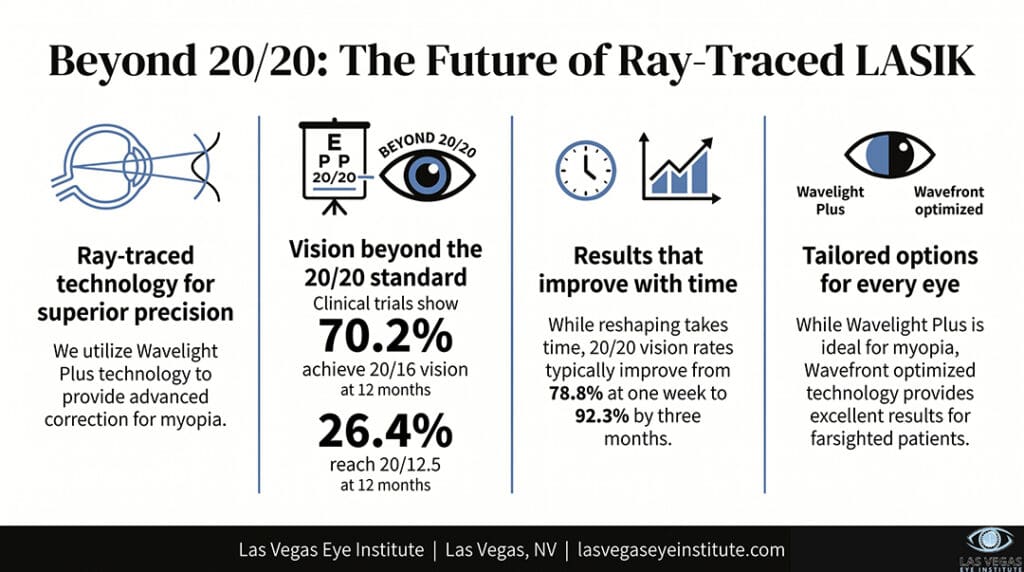
Yes, LASIK can provide better than 20/20 vision for some patients, though results depend on various factors. Over 90% of patients who undergo LASIK achieve 20/20 vision or better, with some studies showing that up to 50% of patients reach better than 20/20. This exceptional level of visual clarity can be life-changing for many, but it’s important to note that not everyone will achieve these exact results. The reality is that in 2026 different results will be seen at different clinics based on the technology that the clinic utilizes and the polices and procedures that are followed in that clinic. At Las Vegas Eye Institute we are using Wavelight Plus Ray-traced Lasik that was only FDA approved in 2025. We began using it in December of 2025 and have found it gets the best myopia results in Dr. Swanic’s 15 year refractive surgery career. In the FDA trial for Wavelight Plus 94.4% of eyes were 20/20 or better at 12 months postop. 70.2% were 20/16 or better at 12 months, and 26.4% were 20/12.5 or better at 12 months. These results are phenomenal and are similar to what we have seen in our clinic. In the Wavelight Plus trial the percentage of patients with 20/20 vision improved from the 1 week to the 3 month visit (78.8% at 1 week vs 92.3% 20/20 at 3 months). So we always let people know that the reshaping of the cornea does stake some time and that vision improves over the first few months with this technology.
That being said Wavelight Plus cannot be used on every case as it is not available for farsighted LASIK and cannot be done on cases with myopia less than 1 diopter (however most people with corrections under 1 diopter don’t seek LASIK.) Both of those groups are still treatable at Las Vegas Eye Institute using our Wavefront optimized technology which is also excellent.
While LASIK has an impressive track record, there are limitations. Age and eye health, for example, play significant roles in determining the final outcome. Additionally, even if 20/20 vision is achieved, some patients may still need reading glasses as they age, due to presbyopia—a common age-related condition. Overall, LASIK has a high success rate, but each patient’s results will vary based on their unique circumstances. A consultation with the experts at Las Vegas Eye Institute can help you understand the specific results you can expect and whether LASIK is the right choice for your vision correction needs.
What factors influence your results from LASIK?
Several factors influence your results from LASIK, such as the level of vision correction needed, pre-existing medical conditions, vision stability, and understanding these can help you set realistic expectations. The level of vision correction you need plays a major role; LASIK is most effective for certain ranges of refractive errors, and more severe vision problems may be harder to correct fully. Pre-existing medical conditions, such as diabetes, can also impact the success of your surgery and recovery. Additionally, if your vision has changed recently or your prescription isn’t stable, your ophthalmologist may recommend waiting until your eyes have settled before undergoing LASIK.
Age is another important factor, as LASIK is typically not recommended for those under 21 because their eyes are still developing. Medications, whether over-the-counter or prescription, can affect the way your body responds to the procedure, so it’s important to inform your surgeon about any drugs you’re taking. One drug to always let your surgeon be aware of is Accutane. People who have taken Accutane for severe acne can still get LASIK but it is recommended that you be off of it for a few months before your evaluation and procedure. Preexisting eye conditions like dry eye or corneal issues can also affect your results or even exclude you from Laser vision correction entirely. Consulting with our UCLA Cornea fellowship trained surgeon, Dr. Swanic, at Las Vegas Eye Institute will help determine if LASIK is the right solution based on these individual factors.
How does the severity of my vision correction impact my chances of achieving better than 20/20 vision with LASIK?
The severity of your vision correction needs can significantly impact your vision results; for example, patients with mild to moderate refractive errors, such as lower levels of nearsightedness, farsightedness, or astigmatism, generally have a higher likelihood of achieving better than 20/20 vision after the procedure. However, with modern LASIK correction, especially Wavelight Plus used at Las Vegas Eye Institute, those with more severe prescriptions still get excellent results. One thing to be aware of though is that Wavelight Plus Lasik is only available to -9.00 corrections. However, most LASIK surgeons typically only use LASIK up to about -8.00 and counsel patients top consider the Evo ICL when their correction goes past that level.
If you look at the percentage of eyes that had less than 0.5 diopters of correction remaining after LASIK in the Wavelight plus trial groups up to -5.00D of preexisting nearsightedness almost 100% of patients had less than 0.5 D remaining. The -5 to -6 group was 92.9%%, -6 to -7 was 82.7%, -7 to -8 was 88.9%, and -8 to -9 was 76%. So it was not a significant drop off in excellent results in any group, but it did show less predictability in the -8 to -9D group.
Your existing visual acuity before surgery also matters; patients who already have better than 20/20 vision with glasses or contacts are more likely to maintain or improve that level after LASIK. Corneal thickness plays a role as well, as individuals with severe refractive errors may require more tissue removal, and thinner corneas can limit the amount of correction possible. Wavelight Plus does use a small amount of tissue more than Wavefront optimized LASIK so in certain patients with thin corneas we will sometimes offer Wavefront optimized LASIK instead of Wavelight Plus Ray-traced LASIK. But you can be assured that both technologies lead to great vision. Wavefront optimized LASIK done at Las Vegas Eye Institute will also be centered directly on your visual axis (Wavelight Plus is automatically centered on the visual axis) which is only available with the newer EX500 Wavelight Laser that we use here. Some practices in Las Vegas are using Wavelight models that preceded the EX500, which do not allow for iris registration and visual axis alignment. These practices can get good results but Dr. Swanic strongly believes in visual axis alignment, especially for farsighted treatments.
Other anatomical factors, like corneal shape and tear film quality, can also influence your chances of achieving superior vision outcomes. While many patients do achieve 20/20 vision or better, the main goal of LASIK is to correct refractive errors and reduce dependence on glasses or contacts. A consultation at Las Vegas Eye Institute will provide a more personalized assessment of your potential results.
Take the Next Step Toward Clearer Vision
If you’re considering LASIK to achieve 20/20 vision or better, the team at Las Vegas Eye Institute is ready to guide you through the process. With a personalized consultation, we can assess your specific vision needs and help you understand the potential results. WE know we have discussed a lot of technology in this FAQ, but the reality is that LASIK in 2026 has come a long way since the original LASIK lasers FDA approved in 1995. We believe in using the latest technology, with the best preoperative diagnostics, and the best surgeon to get you excellent vision. Contact us today to schedule your appointment and take the first step toward clearer, sharper vision.
Take the next step.
Schedule your complimentary consultation today.
FAQ’s About Does LASIK Give You 20/20 Vision Or Better
Can LASIK improve vision beyond 20/20?
Yes, LASIK can and usually does result in better than 20/20 vision for most patients. However, as you can see from the above data we can still see about 5% of patients in the Wavelight Plus Ray-traced LASIK FDA study had vision less than 20/20 in one eye. The good news is that we have TWO eyes so most of those patients probably had 20/20 vision in the other eye, making them 20/20 on the eye chart with both eyes open. This means they were likely doing excellent in their daily activities. Achieving these excellent results depends on factors like the patient’s individual eye anatomy and also the technology and skill of the center you choose. . Dr. Swanic at Las Vegas Eye Institute will thoroughly evaluate your eyes to determine if achieving better than 20/20 is likely based on your unique needs.
How long does it take to achieve 20/20 vision after LASIK?
Many patients experience significant improvement in their vision within 24 to 48 hours after LASIK eye surgery. However, it can take up to six months for your vision to fully stabilize. Dr. Swanic will monitor your healing process at Las Vegas Eye Institute to ensure the best possible outcome during this time.
Is 20/20 vision guaranteed with LASIK?
While LASIK has a high success rate, with over 90% of patients achieving 20/20 vision or better, it cannot guarantee this outcome for everyone. Factors like pre-existing eye conditions, higher refractive error, and individual healing responses may affect results. Dr. Swanic will set realistic expectations during your consultation.
Can LASIK correct astigmatism to 20/20 vision?
Yes, LASIK can effectively treat astigmatism, and many patients achieve 20/20 vision or better after surgery. In the above Wavelight Plus FDA trial, 37.1% of patients had astigmatism greater than 1.0D and these patients are included in the above numbers so we can expect that they also achieve about 90% or above rate of 20/20 vision (the study did not explicitly breakdown visual acuity results in astigmatism patients). LASIK is a type of refractive surgery that reshapes the cornea, improving the way light is refracted by the human eye. Wavelight Plus Ray-traced LASIK actually looks at the shape of your cornea, the length of your eye, and your preexisting glasses prescription to try to focus these rays accurately on your retina to give you crisp vision. The procedure involves creating a small flap in the cornea, followed by excimer ablation which allows for precise correction of astigmatism, myopia (near-sightedness), or hyperopia. Dr. Swanic specializes in ophthalmology (with fellowship training in refractive surgery) and offers advanced laser surgery at Las Vegas Eye Institute to provide optimal outcomes for patients.
Does everyone achieve 20/20 vision after LASIK?
Not everyone will achieve 20/20 vision after LASIK, though most do. Results depend on factors like the severity of the refractive error, corneal thickness, and overall eye health. Dr. Swanic will provide a thorough evaluation to determine your likelihood of achieving 20/20 vision at Las Vegas Eye Institute.
Can LASIK provide better than 20/20 vision for nearsightedness?
Yes, LASIK often results in vision better than 20/20 for patients with mild to moderate nearsightedness, also known as myopia. Patients with high degrees of myopia or an unstable eyeglass prescription may experience variable outcomes. Dr. Swanic will tailor your treatment plan to maximize your results, improving your overall quality of life by reducing the need for corrective lenses.
Will I still need glasses if I get 20/20 vision after LASIK?
While LASIK surgery can reduce or eliminate the need for glasses for most tasks, some patients may still need reading glasses as they age due to presbyopia. LASIK improves your visual perception and reduces dependence on corrective lenses, including both glasses and contact lenses. Dr. Swanic will explain how LASIK can improve your vision and whether additional correction may be needed as you age. We can discuss the option of blended vision LASIK if you are in your 40s and are having near vision issues. Dr. Swanic and his team will try to make your non dominant eye slightly more blurry at distance so that you will have better near vision without glasses. We are very good at this, as this is our default for patients over 45, but some patients may not be a good candidate for this and we will discuss it at your preoperative evaluation.
How long does 20/20 vision last after LASIK?
For most patients, the results of LASIK are long-lasting, and many maintain 20/20 vision for years. However, natural aging processes like presbyopia may affect your vision over time. Dr. Swanic and the team at Las Vegas Eye Institute will provide long-term care to help you maintain clear vision.
Is LASIK safe if I want 20/20 vision?
LASIK is a safe and effective procedure for improving vision to 20/20 or better in most patients. It’s one of the most popular forms of refractive surgery in the United States, widely used in both optometry and ophthalmology. Dr. Swanic at Las Vegas Eye Institute uses advanced laser technology to ensure optimal results and improve visual acuity.
Can I achieve 20/20 vision if I have thin corneas?
If you have thin corneas, achieving 20/20 vision with LASIK may be more challenging, as there is less tissue available for reshaping. When patients have thin corneas they may be a better candidate for a different procedure like PRK (also called ASA or Advanced Surface Ablation) or Evo ICL. However, Dr. Swanic will assess your corneal thickness and discuss alternative options, if needed, to improve your vision at Las Vegas Eye Institute.
What factors could impact my LASIK results?
In some cases, conditions like dry eye syndrome can affect the healing process after LASIK. Additionally, patients with more severe refractive errors or visual impairments, such as myopia, may require more time to see full results. Dr. Swanic will consider these factors, along with your refraction and overall eye health, to determine your suitability for LASIK.
https://www.nvisioncenters.com/improve-eyesight/20-20-lasik/
https://www.tlcvision.com/blog/lasik-success-rate/
https://www.mariettaeye.com/eye-care-info/lasik-eye-surgery-statistics/
https://www.lasikplus.com/lasik-resources/what-is-lasik/does-laser-eye-surgery-deliver-2020-vision/
https://visionaryeyecentre.com/does-lasik-give-you-20-20-vision/
https://www.tlcvision.com/blog/lasik-success-rate/
https://dmei.org/blog/what-is-the-best-vision-you-can-have/