
A patient-friendly guide to the newest generation of customized LASIK.
Ray-traced LASIK is one of the most exciting upgrades to modern LASIK because it is highly customized to each individual eye. Below, I explain what it is, how it compares to earlier generations of customization, and what you should realistically expect.
What is ray-traced LASIK?
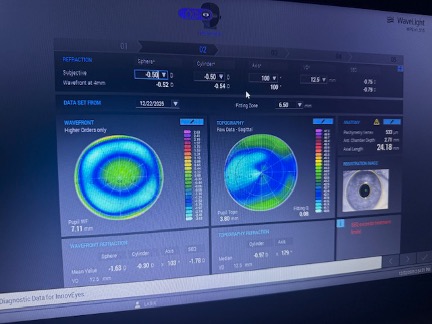
Ray-traced LASIK is the newest form of LASIK available in the United States. It was FDA approved under the trade name Alcon WaveLight Plus in Spring of 2025. I had the chance to be one of the first surgeons in the country to experience the Sightmap capture device for it first hand at the ASCRS meeting in Los Angeles. This was in May of 2025, just a few weeks after approval, even before its commercial launch. In simple terms it is LASIK that is highly customized to each individual eye. It starts with a detailed analysis of the cornea (the structure that we do LASIK on.) It uses a rotating digital camera to capture thousands of corneal data points. Then it measures the length of your eye to the center of your vision so it can try to focus the rays of light directly on the center of your vision. Lastly it uses a wavefront sensor to measure your refractive error down to 1/100th of a diopter allowing for an extremely accurate ray-traced treatment profile leading to excellent vision.
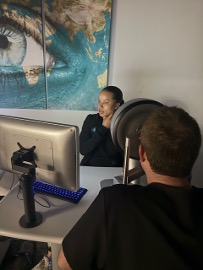
How it differs from wavefront-guided, wavefront-optimized, and topography-guided LASIK
These are great questions and I have been fortunate enough to use all three in my career. I actually had wavefront guided PRK performed on my own eyes at the end of residency. It was performed on a laser that is nearly out of existence at this point called the Visx Star S4IR. Its capture device was called the CustomVue and it was cutting edge at the time but it only used about 250 focusing beams on your retina. This meant its resolution was far lower than the iDesign that replaced it in 2015 with 1250 focusing points. Wavefront guided LASIK like the iDesign and Customvue only use the wavefront to guide your treatment plan. The Customvue didn’t measure the cornea at all. When iDesign came out they did measure the cornea but it wasn’t to fine tune the treatment like in Ray-traced LASIK. The iDesign captured corneal topography was simply used to modulate the energy delivery of the wavefront treatment. This meant that in iDesign LASIK the cornea wasn’t being factored into the treatment plan. I used the iDesign on my best friend from high school, so you better believe I thought it was great! And I still see great 15 years after my procedure. This means we’ve been good at LASIK for a long time.
But times move on. Topography guided LASIK, also known as Contoura, commercially launched in 2016 and it allowed precise corneal measurements that could treat very small corneal irregularities but it didn’t have a wavefront capture device. This meant that Contoura topography guided treatments were calculated off of refractive data combined with topography data. This means the surgeon would just put in your glasses prescription and the software would calculate a custom treatment based on the topographic data combined with that prescription.
Wavefront optimized LASIK is essentially the same as Contoura where your surgeon programs a glasses prescription but then the laser optimizes the ablation peripherally to decrease night vision glare issues. I used wavefront optimized treatments on my brother, his wife, and one of my employees. All with astounding results.
Ray-traced LASIK is essentially a combination of all of the above that harnesses the advances of modern computer ray tracing calculations to mix the data from your detailed corneal data, your wavefront data, your glasses data, and the length of your eye to get the light beams focused right on your retina. This has primarily lead to higher amounts of patients getting vision beyond 20/20. All of our current LASIK technologies have been amazing. And in fact most of them are still going to be useful. I will still be performing Contoura on highly irregular corneas. And I suspect wavefront optimized will still have its place for certain patients as well. Think of this as new tool on my Swiss Army Knife. I’m not throwing away the Swiss Army knife, I’m just adding to it.
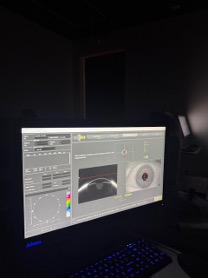
How the ray-trace plan improves the treatment design
Well if we go back to the above you can see that the wavefront allows treatment down to 100th of a diopter, the digital corneal imaging allows custom treatment to your cornea, The length of the eye lets the rays know exactly where to come to focus, and lastly the visual axis is perfectly measured and transferred to the laser so that your treatment is perfectly centered on your visual axis. Most patients don’t know this but very few humans actually have the center of their pupil as their visual axis. This made our prior wavefront guided treatments that were captured on the center of the pupil and subsequently centered on the pupil great for people who have the center of the pupil as the center of their visual axis. But it was not so great for people that have their visual axis slightly shifted nasally (most humans have a slight nasal shift of their visual axis.) Ray tracing lets us account for this and further customize your treatment to YOUR eye. (BTW we also have been doing this alignment with our Contoura and Wavefront optimized treatments ever since we purchased this platform 4 years ago.)
Who is (and isn’t) a candidate?
Well first off it is only approved for near sighted treatments at present. But that’s ok because the vast majority of people seeking LASIK are nearsighted (in our practice over 80%.) Second you can only have 3 diopters of refractive astigmatism, but that is going to include over 95% of people seeking LASIK as it is really rare to see corrections over 3 diopters of astigmatism. Ray-traced LASIK requires a minimum treatment of 1 diopter of nearsightedness and can treat up to 9 diopters of nearsightedness. This covers over 95% of nearsighted LASIK candidates because people with less than 1 diopter of myopia rarely seek LASIK (although we can perform it with wavefront optimized at Las Vegas Eye Institute) and people with over 9D of correction are almost all recommended Evo ICL in 2025.
You need to have a detailed eye exam to be a candidate and we recommend seeking a physician like Dr. Swanic who has completed a fellowship in Cornea and Refractive surgery at the world-renowned Jules Stein Eye Institute at UCLA. We will examine your eyes more than you can imagine. Your corneal shape will be carefully examined with multiple topographers, the thickness will be measured with multiple devices over thousands of spots to ensure you truly have enough tissue to safely perform the procedure, and lastly we even use the latest epithelial thickness mapping techniques to further identify good candidates and rule out bad candidates. We love doing LASIK at Las Vegas Eye Institute but we never want to do it on someone where it’s not the right procedure for them.
What benefits should you realistically expect?
If I’m being honest… you should expect great vision postop like we have been delivering at Las Vegas Eye Institute for years. I’d like to say it’s going to be SO much better than our treatments done earlier this year. But it’s not like we have been using outdated technology here. We are always on the cutting edge. So you can expect to see 20/20 like our patients before. You can expect that because 94.4% of eyes in the WaveLight plus FDA trial saw 20/20 at one year. 70.2% of eyes were 20/16. 20.6% of eyes were 20/12.5. Unfortunately, the FDA trial did not include binocular vision but since our eyes sum images we can assume that with both eyes open all of these percentages were even higher.
Ray-traced LASIK is likely to give you just a bit crisper vision and a higher likelihood of seeing 20/16 and even 20/12.5 vision. This is what clinical studies have shown in its FDA trial and in data out of Europe where they had access one year ahead of us. The data in peer reviewed publications have even exceeded these results, above was the FDA trial data which tends to be very rigorous. Real world results typically are even better as surgeons tweak results to their particular clinics.
Final thoughts
All of our current LASIK technologies have been amazing. Ray-traced LASIK is simply one more tool in the toolkit that can help the right patient achieve excellent vision.